From Idea to Product: Decisions That Change During Development
Technical decisions become useful when they are connected to requirements, evidence and the intended manufacturing context.
The problem
Product development is often shown as a straight line. In practice, new evidence changes requirements, geometry, materials, interfaces and the production strategy.
Context and analysis
Early decisions define the problem and alternatives. Prototypes expose behaviour and user issues. Supplier input clarifies process limits, quantities and investment. Documentation then aligns the selected configuration with testing and manufacturing preparation.
Questions to resolve
- What requirement or risk drives the decision?
- Which variables must be represented?
- What evidence is sufficient for the next stage?
- Which assumptions remain open?
Alternatives
Compare more than one route whenever the decision affects architecture, process or investment. A lower-detail test, standard component or staged launch may provide better evidence before committing to a final configuration.
How Órbita approaches it
Move through problem, requirements, alternatives, evaluation, prototype, test, adjustment and production preparation. At each gate, record what changed, why it changed and which assumptions remain open.
Educational example
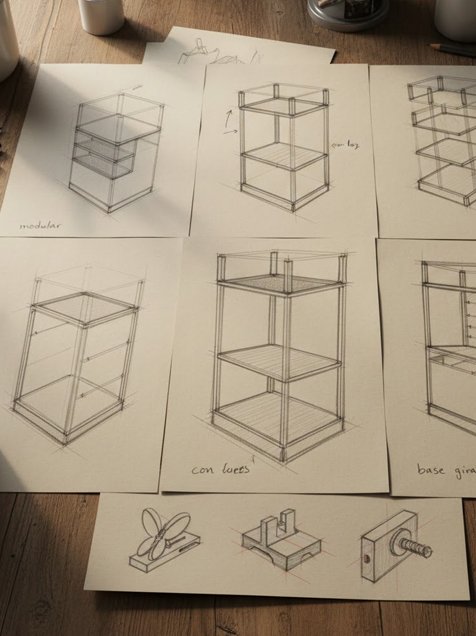
Educational example, not a client case. A modular storage product begins as a single moulded body. Usability tests favour removable trays, while supplier review suggests a mixed process for the first series. The architecture evolves because evidence changes the trade-off, not because the original idea was simply copied into production.
Result of the analysis
The result is a documented decision and a clearer next step. Depending on the evidence, that step may be to advance, modify, simplify, divide the project into stages, change process or discard an alternative.
FAQ
Does this analysis guarantee manufacturing success?
No. It reduces uncertainty for a defined decision; later stages still require appropriate tests, supplier validation and documentation.
When should suppliers participate?
When process capability, quantities, tooling, lead time or components materially affect the decision.
Explore Product Development, Product Feasibility, Prototyping and Design for Manufacturing.